
Manufacturing
People who can run your line.
Operators, assemblers, quality inspectors, maintenance technicians and supervisors. A season, a second shift, a ramp up, or the permanent hire the floor is built around.
- 6 functions
- from the line and the machine through quality, maintenance, materials and supervision
- Shift screened
- second and third shift confirmed before you meet anyone, not discovered in week two
- Volume ready
- one operator or a full second shift, onboarded together
Manufacturing
The shift pattern loses more hires than the skill test.
We staff production and assembly, machining, quality and inspection, maintenance and reliability, materials and planning, and floor supervision. Automotive suppliers, food and beverage, plastics, metals, medical device and general manufacturing.
Volume hiring here is a throughput problem as much as a sourcing one. Onboarding, safety briefing and the first morning decide whether the people you hired are still there in week three.
And the honest constraint is rarely capability. It is shift, commute and pay band, in that order, which is why we confirm all three before anybody is put forward.
Functions
What we actually recruit for.
Pick one and you get what they actually produce, the seniority we fill, and the tools and standards a screen has to cover.
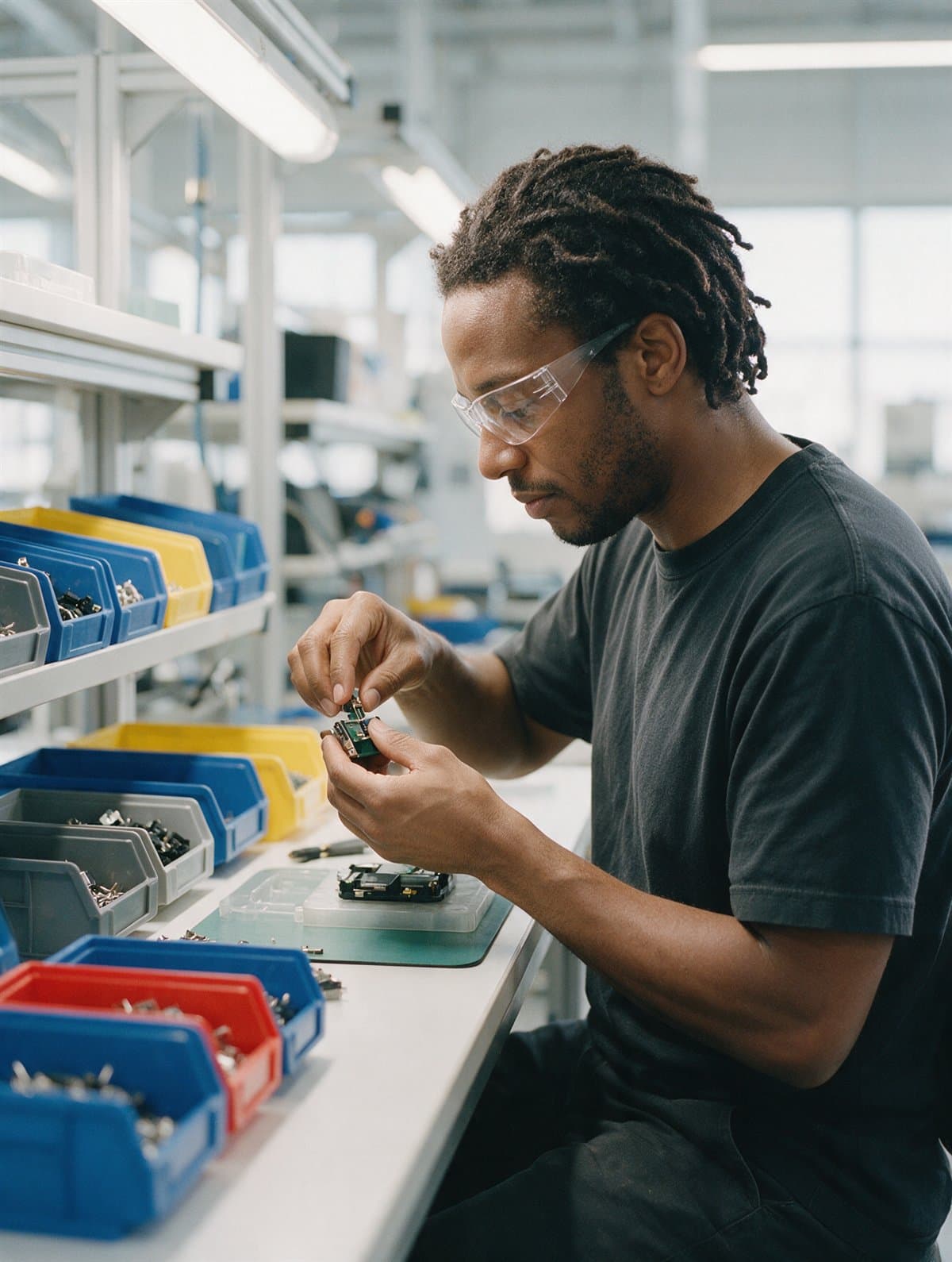
Line work, assembly, packing and the changeovers that decide whether a shift hits its number.
- Seniority we fill
- Entry level through to experienced line lead
- Tools
- Hand and power toolsTorque toolsWork instructionsBarcode scanning
- Standards
- Lockout tagout awareness5SStandard work
Line work, assembly, packing and the changeovers that decide whether a shift hits its number.
- Seniority we fill
- Entry level through to experienced line lead
- Tools
- Hand and power toolsTorque toolsWork instructionsBarcode scanning
- Standards
- Lockout tagout awareness5SStandard work




The vocabulary
What we recruit against.
Equipment, standards and the certifications that decide whether somebody can start on Monday or in three weeks.
Equipment and controls
- Fanuc
- Haas
- Mazak
- Allen-Bradley
- Mastercam
- CMM
- Injection moulding
Systems
- SAP
- MES platforms
- ERP inventory
- CMMS
- Minitab
Standards
- ISO 9001
- IATF 16949
- AS9100
- GMP
- 5S and lean
- Lockout tagout
Certifications we verify
- Forklift and powered industrial truck
- OSHA 10 and 30
- Welding certifications
- Six Sigma
Nobody leaves a manufacturing job in week two because the work was too hard. They leave because nobody told them about the shift.
Screening
How we screen for the floor.
Manufacturing screening fails when it is done as a phone call about a resume. The questions that predict success are practical, and most of them are about the shift rather than the skill.
- 01
The shift, confirmed in detail
Start time, length, rotation, weekends, mandatory overtime. Said plainly to the candidate before anything else, because this is where most placements are lost.
- 02
The work described honestly
Lifting, standing, temperature, noise, pace and cleanroom or PPE requirements. A surprise on day one costs you the hire.
- 03
Practical capability checked
Blueprint reading, measurement, machine familiarity or a short assessment where the role justifies it, rather than a self reported skill list.
- 04
Commute and reliability
How they get there, how far, and what happens if a shift starts at five. Transport is the most common cause of early attrition and the easiest to ask about.
- 05
Certifications verified
Forklift, OSHA, welding tickets and any site specific requirement, checked before the first morning rather than after.
Straight answer
Where the market is actually tight.
What our recruiters see running these searches. Experience rather than a guarantee.
| Role | What the market looks like | Realistic shortlist |
|---|---|---|
| General production and assembly | Available in most markets. Retention rather than supply is the real problem. | Days |
| Material handlers with forklift | Readily available where certification is current. | Days |
| Quality inspectors | Steady. Automotive and aerospace standards depth narrows it. | One to two weeks |
| CNC set up and programmers | Tight in most regions, and worth paying properly for. | Two to four weeks |
| Maintenance technicians | The hardest manufacturing hire we run, particularly with PLC fault finding. | Three to five weeks |
| Production supervisors, off shift | Difficult. Capable supervisors rarely want nights, and the differential decides it. | Three to five weeks |
For volume ramps, the constraint is usually onboarding throughput rather than candidates. Tell us the start date and we will plan backwards from it.
Shapes
Three shapes this usually takes.
Manufacturing demand tends to arrive as a number and a date rather than a job description.
Shift cover
Bodies on the line, this week.
- When it fits
- Absence, a rush order, a seasonal peak, or a second shift you are trialling.
- The arrangement
- Temporary. We are the employer of record and handle safety onboarding.
A volume ramp
Many people starting together against a date.
- When it fits
- A new line, a new customer, a plant expansion, a season with a known shape.
- The arrangement
- Temporary or contract at volume, onboarded in groups with one point of contact.
The permanent hire
The skilled roles the floor depends on.
- When it fits
- Maintenance technicians, CNC set up, quality, supervision.
- The arrangement
- Direct hire, or contract-to-hire where you want to see them on the floor first.
Before you call
What to have ready before you call.
These six answers are what separate a shortlist from a stack of resumes.
- The shift, including rotation, weekends and mandatory overtime
- The physical reality: lifting, standing, temperature, pace and PPE
- Certifications the site requires before somebody can start
- Whether there is transport nearby, and parking
- Headcount and the date it has to be on the floor by
- The pay band, and whether there is a shift differential
Open roles
A sample of manufacturing roles we fill.
Questions
Before you call.
Yes, and volume ramps are a large part of what we do in manufacturing. The planning question is onboarding throughput rather than candidate supply, so tell us the start date and we will work backwards from it.
Need people on the line?
Tell us the shift, the headcount and the date. We will tell you what is realistic before you plan a schedule around it.